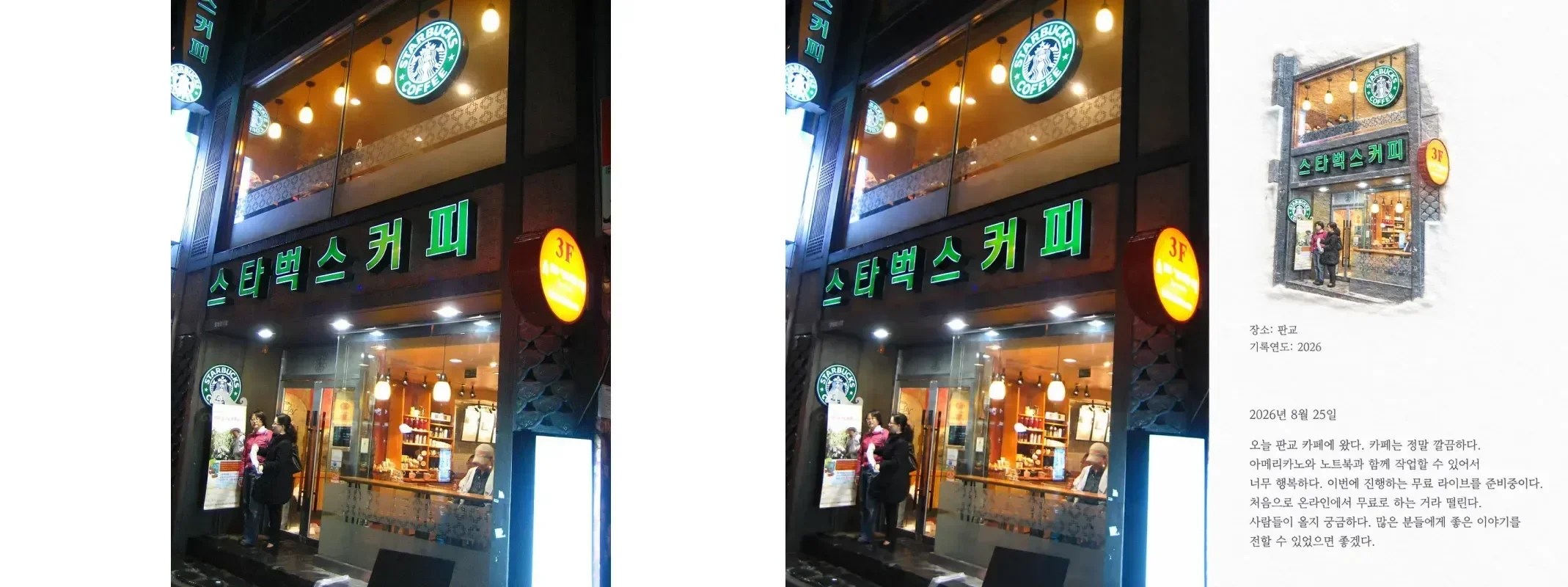
Wikimedia Commons: Starbucks in Seoul South Korea.jpg by BrianAdler (Public domain) · AI-generated sample
Image Edit
일기장 만들기
by @Edmund Hong
0 copies · 20 views
Prompt
Create a separate **Minimal 3D Field Notes Poster** for each uploaded photo. Output each photo individually, never as a collage.

## Layout

Keep the original **4:3 landscape format**.

* **Left 58%:** original uploaded photograph
* **Right 42%:** clean white archival paper
* No visible dividing line

The left side must faithfully preserve the original photograph, including its subjects, architecture, landscape, people, lighting, textures, spatial relationships, and **original color atmosphere**.

Do not redraw, reconstruct, stretch, distort, replace, or significantly recolor the photograph.

Only restrained editorial color grading and extremely subtle fine film grain are allowed.

---

## Right Side — 3D Korean Diary

The right side must use a **clean white archival paper background**.

The paper should be clearly **white, not cream, ivory, beige, yellow, or warm off-white**.

Keep subtle realistic paper fibers, fine matte grain, and very faint natural handling texture, while maintaining an overall **bright neutral-white appearance**.

Arrange vertically:

**COLOR 3D PAPER RELIEF → TRAVEL RECORD → DATE → DIARY**

Keep the composition quiet, sparse, and left-aligned with generous whitespace.

---

## Color 3D Paper Relief

Place a small **shallow 3D embossed relief** in the **upper portion of the right page**.

Analyze the original photograph and extract only its most recognizable visual relationships, such as iconic architecture, skyline, terrain, shoreline, water, vegetation, or other defining spatial elements.

Simplify the scene without losing its identity.

The relief should feel physically pressed into thick white archival paper at approximately **1–3 mm visual depth**, with restrained bevels, subtle paper compression, fiber deformation, delicate shadows, and soft grazing light.

### Preserve the Original Colors

**Color is essential.**

Extract the palette directly from the uploaded photograph and preserve its original colors **as faithfully and artistically as possible**.

Maintain the characteristic sky, water, architecture, vegetation, terrain, atmospheric haze, warm/cool relationships, and natural tonal balance of the original scene.

Allow multiple colors from the original photograph to appear naturally throughout the relief.

Colors should feel **softly absorbed or printed into the white paper while following its embossed surface**, rather than digitally painted or floating above it.

The white paper should remain visible between and around the colored forms.

The result should resemble a miniature artistic translation of the original photograph into:

**shallow 3D embossing + white archival paper + original photographic colors + softly absorbed pigment**

Do not convert the relief into monochrome, sepia, blind embossing, or a washed-out nearly colorless image.

Do not introduce arbitrary colors that are absent from the original photograph.

Keep the 3D effect subtle and physically believable.

---

## Korean Travel Record

Directly beneath the relief, add:

**장소: {장소 입력을 여기에 입력해주세요}**
**기록연도: 2026**

Keep this information very small and understated.

---

## Korean Diary

Below the travel record, leave comfortable whitespace and add:

**{일기를 여기에 입력하세요}**

The diary should feel personal, quiet, warm, and observational.

Keep it small, left-aligned, and comfortably spaced.

---

## Typography

**All visible text on the right side must use KoPub바탕 (KoPub Batang) exclusively.**

Use KoPub바탕 for Korean, English letters, numbers, punctuation, date, travel record, and diary.

Do not use typewriter, sans-serif, handwriting, brush, or decorative fonts.

All Korean characters must be accurate and clearly legible.

---

## Visual Direction

The result should feel like an **architect's private travel field archive transformed into a tactile Korean diary page on clean white paper**.

Overall feeling:

**white, minimal, quiet, colorful but restrained, tactile, precise, personal, and collectible.**

Preserve extensive clean white negative space.

Avoid cream paper, ivory paper, beige backgrounds, yellow paper tones, vintage yellowing, monochrome embossing, arbitrary recoloring, deep relief, floating objects, glossy 3D, plastic textures, oversized typography, dense layouts, decorative borders, logos, seals, postage motifs, or souvenir aesthetics.

**Priority:** preserve the original photograph on the left, use a **clean neutral-white paper background** on the right, preserve the photograph's original colors in the shallow 3D relief, and place the KoPub바탕 Korean travel record and diary naturally beneath it with generous white space.
Create a separate **Minimal 3D Field Notes Poster** for each uploaded photo. Output each photo individually, never as a collage.

## Layout

Keep the original **4:3 landscape format**.

* **Left 58%:** original uploaded photograph
* **Right 42%:** clean white archival paper
* No visible dividing line

The left side must faithfully preserve the original photograph, including its subjects, architecture, landscape, people, lighting, textures, spatial relationships, and **original color atmosphere**.

Do not redraw, reconstruct, stretch, distort, replace, or significantly recolor the photograph.

Only restrained editorial color grading and extremely subtle fine film grain are allowed.

---

## Right Side — 3D Korean Diary

The right side must use a **clean white archival paper background**.

The paper should be clearly **white, not cream, ivory, beige, yellow, or warm off-white**.

Keep subtle realistic paper fibers, fine matte grain, and very faint natural handling texture, while maintaining an overall **bright neutral-white appearance**.

Arrange vertically:

**COLOR 3D PAPER RELIEF → TRAVEL RECORD → DATE → DIARY**

Keep the composition quiet, sparse, and left-aligned with generous whitespace.

---

## Color 3D Paper Relief

Place a small **shallow 3D embossed relief** in the **upper portion of the right page**.

Analyze the original photograph and extract only its most recognizable visual relationships, such as iconic architecture, skyline, terrain, shoreline, water, vegetation, or other defining spatial elements.

Simplify the scene without losing its identity.

The relief should feel physically pressed into thick white archival paper at approximately **1–3 mm visual depth**, with restrained bevels, subtle paper compression, fiber deformation, delicate shadows, and soft grazing light.

### Preserve the Original Colors

**Color is essential.**

Extract the palette directly from the uploaded photograph and preserve its original colors **as faithfully and artistically as possible**.

Maintain the characteristic sky, water, architecture, vegetation, terrain, atmospheric haze, warm/cool relationships, and natural tonal balance of the original scene.

Allow multiple colors from the original photograph to appear naturally throughout the relief.

Colors should feel **softly absorbed or printed into the white paper while following its embossed surface**, rather than digitally painted or floating above it.

The white paper should remain visible between and around the colored forms.

The result should resemble a miniature artistic translation of the original photograph into:

**shallow 3D embossing + white archival paper + original photographic colors + softly absorbed pigment**

Do not convert the relief into monochrome, sepia, blind embossing, or a washed-out nearly colorless image.

Do not introduce arbitrary colors that are absent from the original photograph.

Keep the 3D effect subtle and physically believable.

---

## Korean Travel Record

Directly beneath the relief, add:

**장소: 판교**
**기록연도: 2026**

Keep this information very small and understated.

---

## Korean Diary

Below the travel record, leave comfortable whitespace and add:

**2026년 8월 25일**

**오늘 판교 카페에 왔다. 카페는 정말 깔끔하다. 아메리카노와 노트북과 함께 작업할 수 있어서 너무 행복하다. 이번에 진행하는 무료 라이브를 준비중이다. 처음으로 온라인에서 무료로 하는 거라 떨린다. 사람들이 올지 궁금하다. 많은 분들에게 좋은 이야기를 전할 수 있었으면 좋겠다. **

The diary should feel personal, quiet, warm, and observational.

Keep it small, left-aligned, and comfortably spaced.

---

## Typography

**All visible text on the right side must use KoPub바탕 (KoPub Batang) exclusively.**

Use KoPub바탕 for Korean, English letters, numbers, punctuation, date, travel record, and diary.

Do not use typewriter, sans-serif, handwriting, brush, or decorative fonts.

All Korean characters must be accurate and clearly legible.

---

## Visual Direction

The result should feel like an **architect's private travel field archive transformed into a tactile Korean diary page on clean white paper**.

Overall feeling:

**white, minimal, quiet, colorful but restrained, tactile, precise, personal, and collectible.**

Preserve extensive clean white negative space.

Avoid cream paper, ivory paper, beige backgrounds, yellow paper tones, vintage yellowing, monochrome embossing, arbitrary recoloring, deep relief, floating objects, glossy 3D, plastic textures, oversized typography, dense layouts, decorative borders, logos, seals, postage motifs, or souvenir aesthetics.

**Priority:** preserve the original photograph on the left, use a **clean neutral-white paper background** on the right, preserve the photograph's original colors in the shallow 3D relief, and place the KoPub바탕 Korean travel record and diary naturally beneath it with generous white space.